
Pickleball vs Ping Pong: Key Differences in Rules, Equipment, and Gameplay
Pickleball and ping pong are both fast-paced, skill-driven sports, yet they differ in several fundamental ways.
While both demand sharp reflexes and strong hand-eye coordination, pickleball is played on a larger court with paddles and a perforated ball. In comparison, ping pong takes place on a compact table using lightweight rackets and a small celluloid or plastic ball.
Layout and Court Size
Ping pong, also known as table tennis, is played on a compact table measuring 9 feet long and 5 feet wide, topped with a 6-inch-high net. Conversely, pickleball is played on a much larger 44-by-20-foot court, with a non-volley zone that extends 7 feet from the net on both sides.
Additionally, the net height differs between the two sports, with pickleball’s slightly lower centre height influencing players to use a combination of soft dinks, controlled drives, and calculated lobs. Because of the larger playing area, pickleball naturally demands more movement, wider coverage, and greater physical effort, while ping pong emphasises reaction speed over endurance or distance.
Equipment Differences
The equipment used in each sport also contributes to distinctive playing styles.
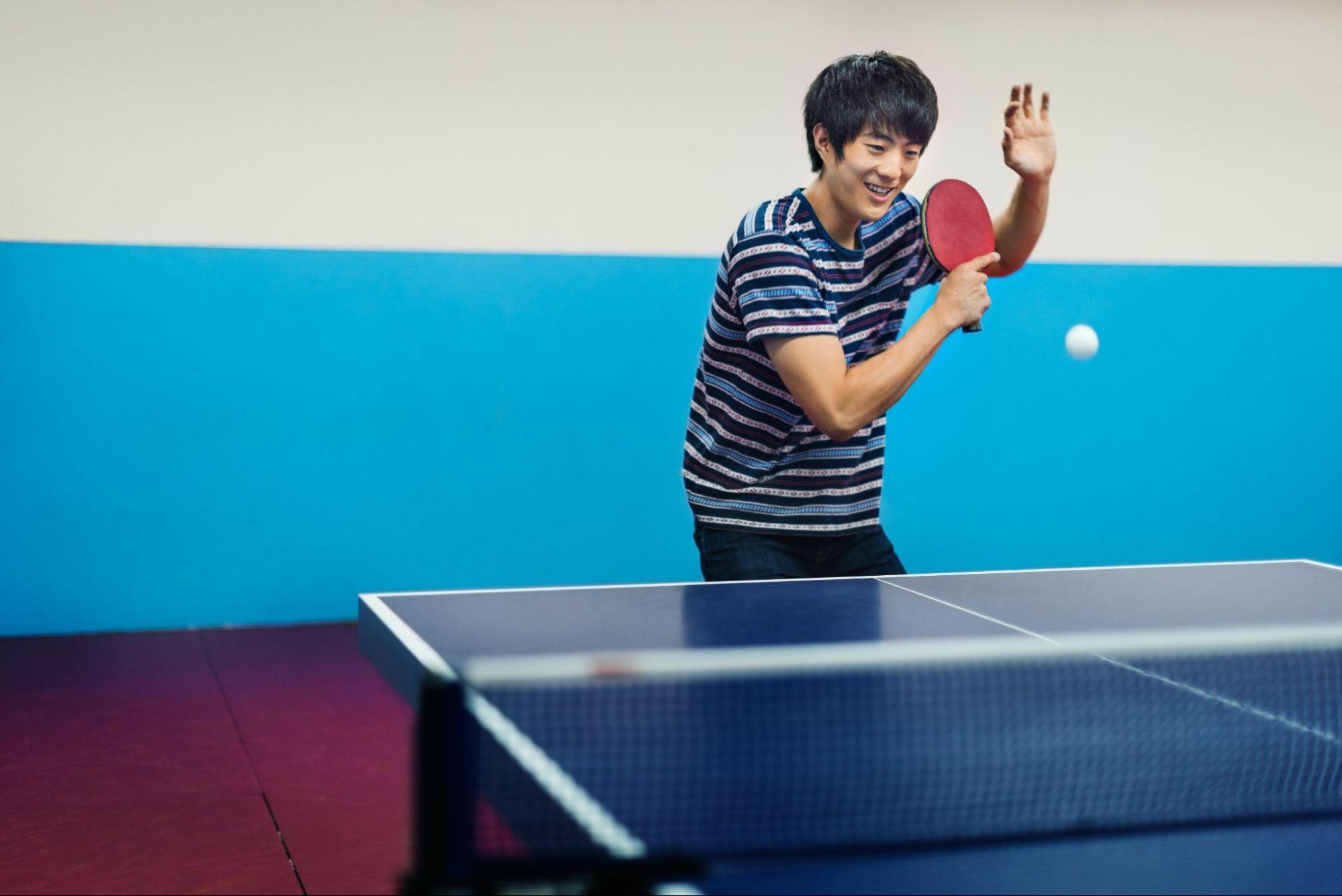
Ping pong paddles are small, lightweight, and traditionally made of wood layered with rubber, allowing players to generate tremendous spin and fast, controlled shots. The hollow 40mm plastic ping pong ball complements this setup, creating rapid bounce and high-spin potential.
Pickleball paddles, however, are larger and crafted from wood or modern composite materials like graphite and carbon fiber. These sturdier paddles generate more power but less spin than ping pong equipment. The balls used in pickleball are heavier, perforated, and specially designed for indoor or outdoor play.
As a result, pickleball rallies often involve a blend of power hits, soft drop shots, and tactical exchanges. In contrast, ping pong rallies revolve around spin manipulation, quick flicks, and high-speed returns.
Gameplay Style and Strategy
Ping pong features high-speed rallies that unfold within seconds, with players relying on rapid reactions, strategic placement, and heavy topspin or backspin to outmanoeuvre their opponents. Meanwhile, pickleball gameplay emphasises tactical depth and strategic patience. Much of the game occurs near the non-volley zone, where players exchange softer shots to force an opening.
Another key contrast is the format: pickleball is most commonly played in doubles, promoting teamwork and coordinated movement, whereas ping pong traditionally favours singles play. Consequently, the pace of play also diverges: ping pong or table tennis thrives on explosive exchanges, while pickleball offers a more measured, chess-like rally structure that requires anticipating full-court responses.
Scoring System
While both sports share the goal of reaching 11 points, their scoring rules create very different match dynamics.
In ping pong, points can be won by either the server or the receiver, with games typically played to 11 and matches structured as best-of-five or best-of-seven. Pickleball, in contrast, allows only the serving team to score, and teams must win by two points. Matches usually follow a best two-out-of-three format.
Serving Rules
There is also a difference between the serving rules of ping pong and pickleball.
In ping pong, players must toss the ball vertically from an open palm and ensure it bounces once on each side of the table. Serves alternate every two points, and doubles play introduces specific rotation rules.
Pickleball serves, however, are underhand and must travel diagonally across the court while clearing the non-volley zone. Importantly, each server gets only one attempt, making accuracy essential. The serve must land beyond the kitchen to be considered legal.
Difficulty and Learning Curve
Ping pong requires advanced spin control, precise timing, and rapid decision-making, making it noticeably harder than pickleball. Players must learn to master spin-heavy serves, fast smashes, and subtle variations in shot speed and placement, all within fractions of a second.
Pickleball, on the other hand, is widely considered more beginner-friendly. The larger court, slower ball, and underhand serve reduce the initial skill barrier, making it easier for newcomers to enjoy rallies right away.
Physical Fitness Requirements
Pickleball requires agility, quick reflexes, and moderate endurance, yet it remains less physically intense than sports like tennis or squash. Court coverage, directional changes, and team coordination are key, especially in doubles play.
Ping pong, by contrast, emphasises fast reaction time, short bursts of movement, and intense cardio endurance. Despite the small playing surface, the rapid pace keeps players constantly alert and active.
Elevate Your Pickleball and Ping Pong Game with Quality Gear From Sin Ten

Whether you prefer the precision of ping pong or the dynamic rallies of pickleball, you can elevate your game by choosing quality gear.
Explore a selection of pickleball rackets, ping pong rackets, and other equipment from Sin Ten, a trusted table tennis shop in Singapore, to start playing with confidence today.
Leave a Comment
You must be logged in to post a comment.
